Hydrogen bonding networks in chiral thiourea organocatalysts. Evidence on the importance of the aminoindanol moiety. Gimeno, M. C.; Herrera, R. P. Cryst. Growth Des., 2016, 16, 5091–5099.
Abstract. The crystal structures of four chiral thioureas,  which are normally used as organocatalysts, are reported by the first time.
Each compound is assembled in the crystal in a different way according to their chiral moiety in the thiourea skeleton, being dependent
on the presence or the absence of the OH group in the aminoindanol or aminoindane moiety, respectively. Thiourea 1, which contains an aminoindane group, is assembled into a zigzag chain linked via N-H•••S hydrogen bonds. Thiourea 2, with an aminoindanol and a phenyl group, interacts mainly through O-H•••S and N-H•••S bonds in a very congested structure. Thiourea 3 disposes in a zigzag chain mainly through S•••OH bonds and in further superposed zigzag chains through NH•••S hydrogen bonds. The compound 4 is coordinated in a coplanar organization via O•••H-N interactions, forming very tight dimers, which are further arranged in chain of dimers through O-H•••S interactions. The general trends in the patterns of packing of these four compounds are compared to those commonly observed in the crystalline solids of other thiourea and urea structures. The different arrangements adopted by our chiral thioureas in the solid state are rationalized and discussed in terms of molecular structure, remarking the importance of the OH group in the aminoindanol scaffold in the determination of the preferred solid assembly. A comparison correlating the crystal structures, specifically the interactions in the crystal network and the configuration adopted by the thioureas, with the catalytic efficiency previously observed by the same structures, is included.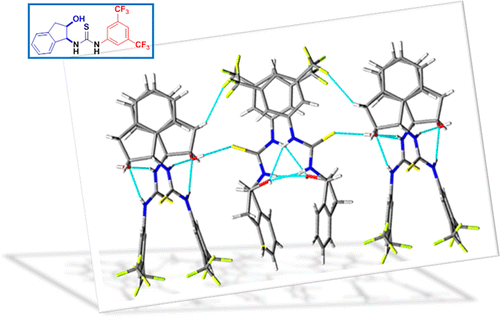











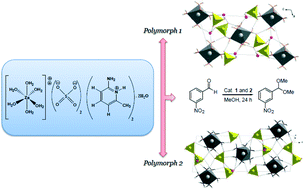
![[1 with combining macron]](https://i0.wp.com/www.rsc.org/images/entities/char_0031_0304.gif) . In an effort to further explore the form diversity of these compounds, the structural arrangements and intermolecular interactions such as hydrogen-bonding and π⋯π interactions are discussed from which supramolecular assembly was formed. Meanwhile, these new polymorphic forms can be described as the stacking of 3D layers where the interlayer distances are 13.23 and 12.59 Å for 1 and 2, respectively. The thermal behaviour of the precursors checked by TG-DTA analysis for both zinc sulfate polymorphs and variable temperature powder X-ray diffraction (VT-PXRD) show successive intermediate crystalline anhydrous phases upon dehydration in 1. The catalytic activity of both polymorphic structures has been tested in the acetalisation reaction of aldehydes as a benchmark process. Interestingly, both complexes showed excellent activity with almost total conversion in many examples and using MeOH as solvent and as the unique source of acetalisation.
. In an effort to further explore the form diversity of these compounds, the structural arrangements and intermolecular interactions such as hydrogen-bonding and π⋯π interactions are discussed from which supramolecular assembly was formed. Meanwhile, these new polymorphic forms can be described as the stacking of 3D layers where the interlayer distances are 13.23 and 12.59 Å for 1 and 2, respectively. The thermal behaviour of the precursors checked by TG-DTA analysis for both zinc sulfate polymorphs and variable temperature powder X-ray diffraction (VT-PXRD) show successive intermediate crystalline anhydrous phases upon dehydration in 1. The catalytic activity of both polymorphic structures has been tested in the acetalisation reaction of aldehydes as a benchmark process. Interestingly, both complexes showed excellent activity with almost total conversion in many examples and using MeOH as solvent and as the unique source of acetalisation.











 Herrera-OrganoCatalisis Asimétrica Group