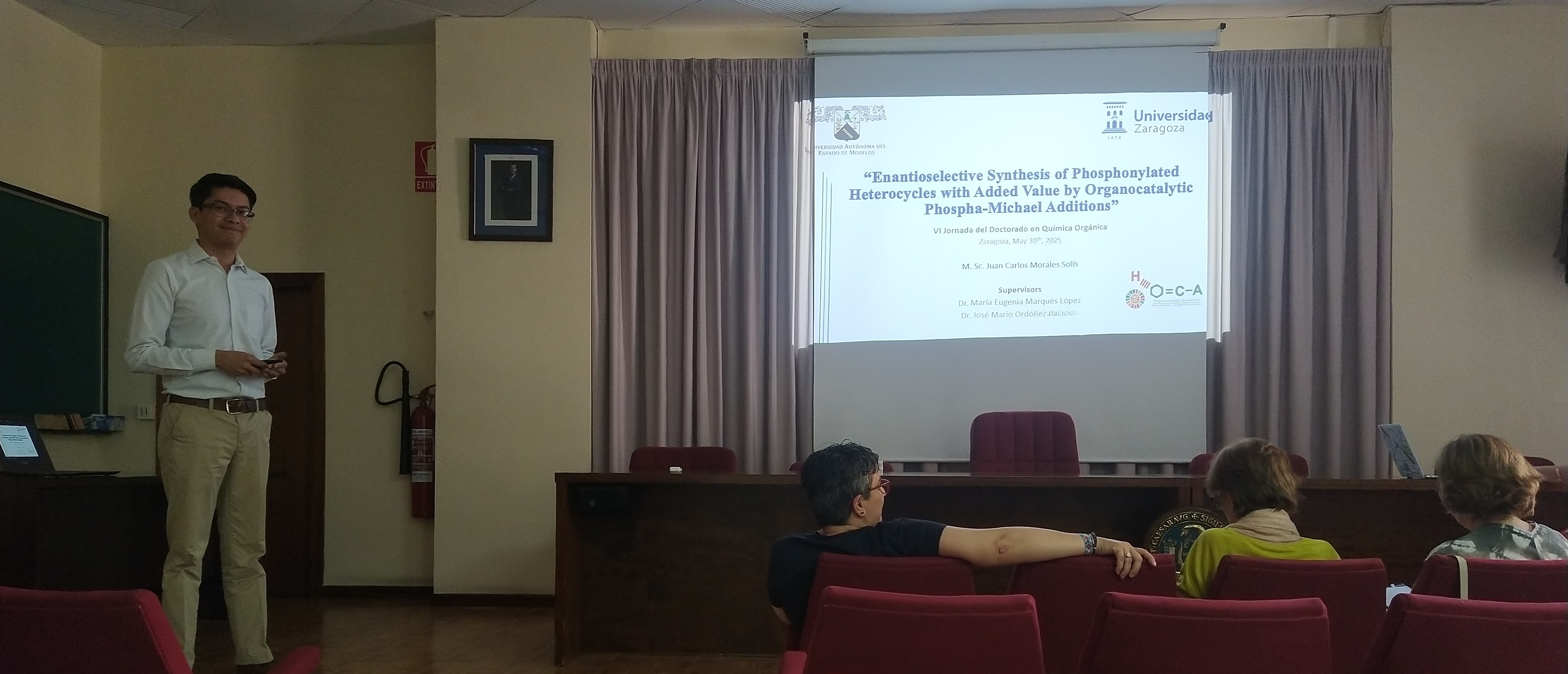
Juan Carlos presented the progress report of his doctoral research plan. Congratulations!

On May 30th, Juan Carlos presented his research progress to the academic committee of the PhD program in Organic Chemistry. This presentation was part of the annual evaluation of doctoral training, specifically for his second academic year at the University of Zaragoza. However, he is actually in the final stage of his PhD, as this is a joint supervision (cotutelle) thesis with the State University of Morelos in Mexico, where he began in 2022.

Posted in Doctorate | Tagged , , , , , | Leave a comment

Just published our first results in CPC (chiral proton catalysis)

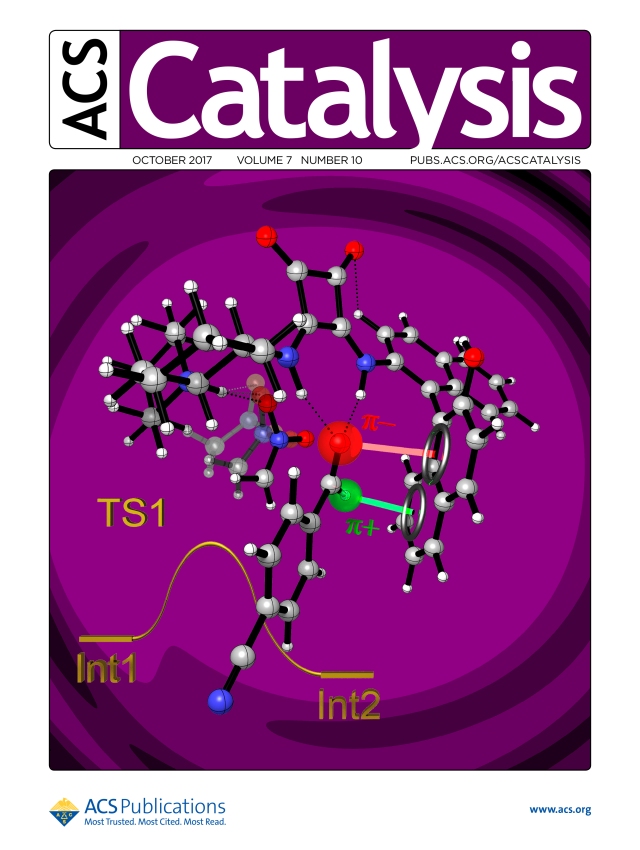
Understanding Chiral Proton Catalysis Using Cinchonium Derivatives in aza-Michael Additions, Auria-Luna, F.;  Marqués-López, E.; Gimeno, M. C.; Alegre-Requena, J. V.; Herrera, R. P.; Adv. Synth. Catal. 2025, e202401458, early view. DOI: 10.1002/adsc.202401458.

Abstract. This work presents a detailed mechanistic study of a quininium-catalyzed aza-Michael reaction, providing essential information for advancing chiral proton catalysis (CPC). The use of cinchona derivatives as chiral proton catalysts demonstrates their potential beyond their conventional roles as base-promoted and phase-transfer catalysts. Competitive reaction pathways are explored using density functional theory (DFT), wavefunction theory, and microkinetic simulations. Theoretical analyses are complemented with experimental titration and kinetic techniques to verify the intrinsic details of the reaction. This study reveals an intricate hydrogen bond network formed in the rate- and selectivity-determining step, involving four noncovalently attached components that favor a stronger substrate⋅⋅⋅catalyst interaction in the R transition state. Significantly, this research emphasizes the pivotal role of carboxylate anions as nucleophile-activating bases impacting reaction yield and enantioselectivity. Therefore, this work introduces cinchonium derivatives as new options for CPC and provides a thorough mechanistic analysis significant in expanding this underdeveloped catalytic domain.

Congratulations!!!

Posted in Publication | Tagged , , , , , , , , , , | Leave a comment

Collaborations bear fruit (gels). Congratulations!

Ultrasound-Enhanced Gelation of Stimuli-Responsive and Biocompatible Phenylalanine-Derived Hydrogels, Buxaderas, E.; Moglie, Y.; Baz Figueroa, A.; Alegre-Requena, J. V.; Grijalvo, S.; Saldías, C.; Herrera, E. P.; Marqués-López, E.; Díaz Díaz, D. Gels 202511(3), 160. DOI: 10.3390/gels11030160.

Abstract. Stimuli-responsive materials, particularly supramolecular hydrogels, exhibit a dynamic adaptability to external factors such as pH and ultrasound. Among these, phenylalanine (Phe)-derived hydrogels are promising due to their biocompatibility, biodegradability, and tunable properties, making them ideal for biomedical applications. This study explores the effects of pH and ultrasound on the gelation properties of N-substituted Phe derivatives, with a primary focus on the role of ultrasound in optimizing the gelation process. A series of N-substituted Phe derivatives were synthesized via reductive amination and hydrolysis. Hydrogel formation was possible with two of these compounds, namely G1 and G2, using the following two methods: heating–cooling (H–C) and heating–ultrasound–cooling (H–US–C). The critical gelation concentration (CGC), gelation kinetics, thermal stability (Tgel), and viscoelastic properties were assessed. Morphological and cytotoxicity analyses were performed to confirm the suitability of these gels for biomedical applications. Both G1 and G2 derivatives demonstrated enhanced gelation under the H–US–C protocol compared to H–C, with notable reductions in CGC (up to 47%) and gelation time (by over 90%). Ultrasound-induced gels led to an improved network density and stability, while maintaining thermal reversibility and mechanical properties comparable to those of hydrogels formed without ultrasound. Cytotoxicity studies confirmed a high biocompatibility, with cell viability rates above 95% across the tested concentrations. Given the similar rheological and morphological properties of the hydrogels regardless of the preparation method, drug release experiments were performed with representative gel samples and demonstrated the efficient encapsulation and controlled release of 5-fluorouracil and methotrexate from the hydrogels, supporting their potential as pH-responsive drug delivery platforms. This study highlights the role of ultrasound as a powerful tool for accelerating and optimizing the gelation process of supramolecular hydrogels, which is particularly relevant for applications requiring rapid gel formation. The developed Phe-based hydrogels also demonstrate promising characteristics as drug delivery systems.

Keywords: supramolecular hydrogel; amino acid; phenylalanine; ultrasound; sonogelation; drug release

Posted in Collaboration, Gel, Publication | Tagged , , , , , , , , | Leave a comment

Collaborations bear fruit (antiproliferative effects). Congratulations!

Multimodal antiproliferative effects of oleanolic acid mitocans: in vitro and in vivo studies, Puerta, A.; González-Bakker, A; Romanos, E.; Aguilar Domínguez, I.; Martínez-Montiel, M.; Merino-Montiel, P.; Herrera, R. P.; Gimeno, M. C.; Fernández-Bolaños, J. G.; López, O.; Padrón, J. M. Biochem. Pharm. 2025234, 116807. DOI: 10.1016/j.bcp.2025.116807.

Abstract. Mitochondria-targeting drugs (mitocans) based on organic cations are emerging as powerful and selective cancer therapeutics. In this study, we have evaluated a novel series of oleanolic acid-derived mitocans, revealing nanomolar-range antiproliferative effects against human solid tumor cells. Continuous live-cell imaging revealed extensive cytoplasmic vacuolation, while mechanistic studies identified paraptosis as the dominant form of cell death. Remarkably, in vivo experiments demonstrated significant tumor growth inhibition in mice, with no detectable toxicity at therapeutic doses. These findings highlight the potential of oleanolic acid-derived mitocans as promising candidates for cancer therapy.

Posted in Cancer, Collaboration, Publication | Tagged , , , , , , , , , , , , | Leave a comment

Our latest findings on the organocatalytic synthesis of heterocyclic derivatives just accepted for publication

Congratulations!!!

Multicomponent Cyanation of 2-Amino-3-cyano-4H-chromenes in Aqueous Media, Ardevines, S.; Garcés-Marín, M.; Cervantes-Cerrada, P.; Aamir, S.; Herrera, R. P.; Marqués-López, E. Asian J. Org. Chem.  2024, e202400443, early view. DOI: 10.1002/ajoc.202400443.

Abstract. Chromenes represent a pivotal molecular structure found in a diverse range of biologically active compounds. Specifically, derivatives of 2-amino-3-cyano-4H-chromene have demonstrated pharmacological applications, displaying potential antioxidant and anticancer activities. This has heightened interest in the exploration of new and more efficient methods for their synthesis. In recent years, few examples have emerged, focusing on the organocatalytic and enantioselective synthesis of 2-amino-3-cyano-4H-chromene derivatives, although the overall number of works to date is limited. In this study, we present the results of the synthesis of 2-amino-4H-chromen-3,4-dicarbonitriles through a Michael addition of cyanide to 2-iminochromenes. To achieve this, we utilized a mild source of cyanide (acetone cyanohydrin), green solvents and catalytic conditions at room temperature, via a multicomponent approach. Furthermore, we initiated the enantioselective study of this process using chiral organocatalysts obtaining promising preliminary results.

Posted in Publication, Uncategorized | Tagged , , , , , , , , , , , , , | Leave a comment

Nice July month in terms of publications!

Congratulations Juan Carlos, Guillermo, Raquel and Conchita!

New Twists in the Chemistry of Thioureas: 1,3-Thiazolidines as a Vector of Sustainability, Guillermo Canudo-Barreras, G.; Herrera, R. P.; Gimeno, M. C. Chem. Eur. J. 2024, e202402812, early view. DOI: 10.1002/chem.202402812.

Abstract. This study introduces a sustainable and pioneering cascade synthesis of 1,3-thiazolidine derivatives under eco-friendly conditions. The methodology transcends traditional approaches yielding complex novel compounds with unique N,S-heterocyclic structures. By operating at room temperature, utilizing green solvents, and minimizing excess of reactants, this procedure offers an innovative pathway for sustainable chemical development. Notably, this method not only prioritizes sustainability but also delivers high-purity products with exceptional yields. The simplicity of the process, requiring only a simple filtration and featuring short reaction times, underscores its efficiency and utility.

Exploring Ferrocenyl Imine-Phosphane Complexes in Gold(I) Redox Switchable Catalysis and the Role of the “Magic Blue” Oxidant, Pérez-Sánchez, J. C.; Herrera, R. P.; Gimeno, M. C. Adv. Synth. Catal. 2024, 366, early view. DOI: 10.1002/adsc.202400593. Hot Topic: Gold

Abstract. Another class of gold(I) redox-switchable catalysts, incorporating ferrocenyl phosphane-imines, enriches the existing library of gold(I) complexes. Our catalyst proves efficacy in gold(I)-catalyzed cyclizations of furans and benzamides, exhibiting reversible “on-off” switching. Furthermore, we explored the unconventional role of “Magic Blue”, commonly used as an oxidizing agent in various organic transformations, as a potential activator of the Au−Cl bond, initiating conventional gold(I) catalysis.

Posted in Publication | Tagged , , , , , , , , , , , | Leave a comment

Getting deeper in the understanding of gold catalysis

Congratulations Juan Carlos, Raquel and Conchita!

The Potential of Self-Activating Au(I) Complexes in Gold Catalysis, Pérez-Sánchez, J. C.; Herrera, R. P.; Gimeno, M. C. Chem. Eur. J. 2024, e202401825. DOI: 10.1002/chem.202401825.

Abstract. Gold catalysis has emerged as a groundbreaking field in synthetic chemistry, revolutionizing numerous organic transformations. Despite the significant achieved advancements, the mechanistic understanding behind many gold-catalyzed reactions remains elusive. This Concept article covers the so-called “self-activating” Au(I) complexes, sorting out their pivotal role in gold catalysis. We comment on how Au(I) complexes can undergo self-activation, triggering diverse catalytic transformations without the need for external additives. The most important examples reported so far that underlie the catalytic activity of these species are discussed. This intrinsic reactivity represents a paradigm shift in gold catalysis, offering new avenues for the design of efficient and sustainable catalytic systems. Furthermore, we explore the factors influencing the stability, reactivity, and selectivity of these Au(I) complexes, providing insights into their synthetic utility and potential applications in synthesis. This area of research not only advances our fundamental understanding of gold catalysis but also paves the way for the development of novel catalytic strategies with broad implications in organic synthesis and the chemical industry.

Posted in Publication | Tagged , , , , , , , , | Leave a comment

Enzymes and Organocatalysts, good coworkers!

Congratulations to Christian, Raquel and Juan!!

Chemoenzymatic One-Pot Cascade for the Construction of Asymmetric C-C and C-P Bonds via Formal C-H ActivationAscaso-Alegre, C.; Herrera, R. P.; Mangas-Sanchez, J. ChemCatChem 2024, e202400817. DOI: 10.1002/cctc.202400817.

Abstract. The integration of organocatalysis and enzyme catalysis in one-pot cascade processes allows for the efficient construction of complex molecular architectures with high levels of stereocontrol. However, challenges related to reaction compatibility between both processes are often a limitation for the development of efficient synthetic routes. In this study, we describe the combination of an enzymatic aerobic oxidation followed by the squaramide-mediated asymmetric formation of C-P and C-C bonds to access important building blocks such as chiral α-hydroxyphosphonates and β-nitro alcohols in good yields and enantiomeric ratios. This sequential process is conducted in a one-pot fashion within a biphasic system and represents a pioneering example of a chemoenzymatic cascade involving aerobic biooxidation and an organocatalytic step operating under hydrogen-bond activation mode and under mild reaction conditions.

Posted in Publication | Tagged , , , , , , , , , , , , , , , , , | Leave a comment

III Symposium on Molecular Chemistry and Catalysis

Last Friday, June 7th, we all enjoy the annual meeting of our research institute. Our guys presented successfully their work and we learnt a lot from our colleagues. Congratulations to the organizing committee! And of course, also to Juan Carlos and Guillermo for their prizes to the 3rd best Flash and 1st best Oral communication, respectively!!!

Posted in ISQCH, Meeting | Tagged , , | Leave a comment

Sandra got published her first results from her stay in Münster

Last summer Sandra spent 3 months at Universität Münster, working in García Mancheño Group. She enjoyed a lot and also ensured nice fruits. Thank you, Olga, for being open for collaboration and hosting our girl!

Congratulations for this first article!

Hydrogen-Bonding Organocatalysis Enabled Photocatalytic Intramolecular [2+2]-Cycloaddition Reaction, Stefania PerulliOm DesaiSandra ArdevinesMustafa UygurSamuel Delgado-HernándezOlga García Mancheño Adv. Synth. Catal. 2024, 366, 751-756 (https://doi.org/10.1002/adsc.202301217)

Abstract. The combination of organocatalytic activation and photocatalysis for enabling the intramolecular [2+2]-cycloaddition of enone-ene substrates bearing one Lewis base binding site is reported. While in a variety of solvents a poor conversion or no reaction takes place in the absence of a hydrogen bonding catalyst, the corresponding ring-fused cyclobutane products could be built in moderate to good yields using a synergistic dual iridium-urea co-catalytic system. Control and mechanistic studies supported the postulated interaction between the organocatalyst and the substrate, which proved essential for an efficient energy transfer from the photosensitizer.

Posted in Publication, Research stay | Tagged , , , , , , , | Leave a comment