
Understanding Chiral Proton Catalysis Using Cinchonium Derivatives in aza-Michael Additions, Auria-Luna, F.; Marqués-López, E.; Gimeno, M. C.; Alegre-Requena, J. V.; Herrera, R. P.; Adv. Synth. Catal. 2025, e202401458, early view. DOI: 10.1002/adsc.202401458.
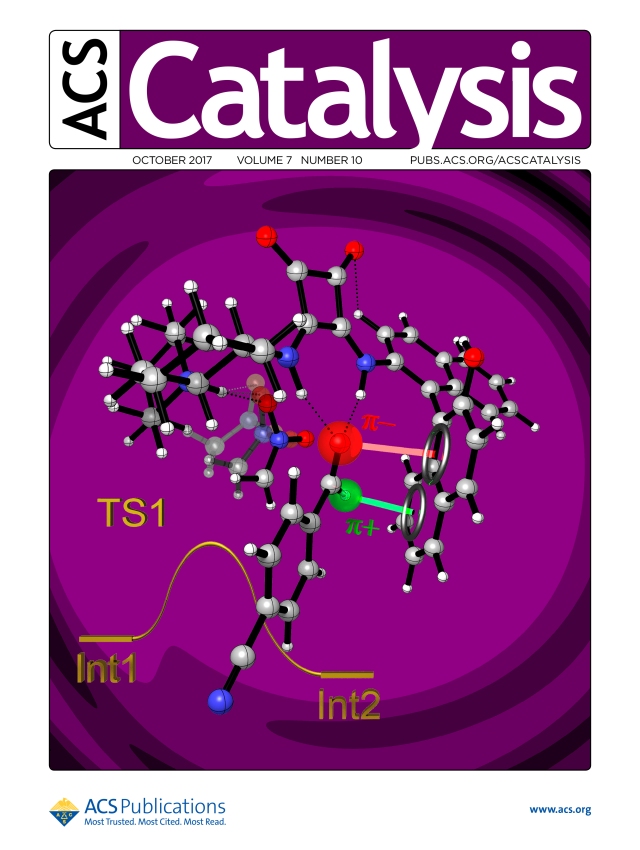
Abstract. This work presents a detailed mechanistic study of a quininium-catalyzed aza-Michael reaction, providing essential information for advancing chiral proton catalysis (CPC). The use of cinchona derivatives as chiral proton catalysts demonstrates their potential beyond their conventional roles as base-promoted and phase-transfer catalysts. Competitive reaction pathways are explored using density functional theory (DFT), wavefunction theory, and microkinetic simulations. Theoretical analyses are complemented with experimental titration and kinetic techniques to verify the intrinsic details of the reaction. This study reveals an intricate hydrogen bond network formed in the rate- and selectivity-determining step, involving four noncovalently attached components that favor a stronger substrate⋅⋅⋅catalyst interaction in the R transition state. Significantly, this research emphasizes the pivotal role of carboxylate anions as nucleophile-activating bases impacting reaction yield and enantioselectivity. Therefore, this work introduces cinchonium derivatives as new options for CPC and provides a thorough mechanistic analysis significant in expanding this underdeveloped catalytic domain.
Congratulations!!!











 Herrera-OrganoCatalisis Asimétrica Group